John Muir Trail Fishing
I did last year (Aug/Sep 2005). Fly fishing is by far the best way to go in the high country as the fish eat bugs almost exclusively. I spoke to people using spinning gear and some had success in specific waters, a few were skunked throughout. There are a number of guidebooks. I used Beck’s “Trout Fishing the John Muir Trail” and it proved to be useful and surprisingly accurate when discussing presentation and fly selection. For example, at Guitar Lake, just below Mt. Whitney, Beck said to use the smallest fly possible.
John Muir National Recreation Trail: Hiwassee River Segment is a 16.4 mile lightly trafficked point-to-point trail located near Reliance, Tennessee that features a river and is rated as moderate. The trail offers a number of activity options and is accessible year-round. Dogs are also able to use this trail but must be kept on leash.
I got many refusals with a selection of #14-#18 flies. After tying on a #24 Mosquito imitation I took (and released) at least ten 10-inch Goldens in the next half-hour. The JMT is a wonderful trip and the fly fishing experience just makes it all the better. I have never heard that flies are better in the high-country as a rule. Having used both spinner and fly methods in a variety of locations and situations I tend to find that in California high country, whether streams or small lakesa 1/16 oz. Panther Martin (gold/black) is one of the most effective elements for catching ANY kind of trout. A month ago I caught 14 – 8 to 10 inch Brookies (in 2 hours) in a Trinity Alps lake at 7200′ that has not been stocked since the 1920’s.
Those fish were more or less native at this point and were very hungry! I suppose the right nymph would have produced the same productivity, but you really have to know the lake/season or be an entomologist. Dry flies would definitely not have worked. Scott,The fish up there have a very short feeding season and will often go after anything that resembles a protein source and fits in their mouth (ever wonder where all the Yellow-legged frogs went?).
Last year at Chief Lake just below Silver Pass I saw a guy take about a dozen nice fish on a spinner — one after another. However, he had been shut out on several other lakes and many of the streams were difficult to work with a spinner.
In 18 days on the JMT I never fished a piece of water that I didn’t take at least one fish. Fly selection was not rocket science and although I caught most on dry flys, a significant number came to nymphs bounced through the riffles.On Marie lake, just below Selden Pass, I experienced the unique situation of actually getting tired of catching fish after landing over 30 Brookies in the 10-12 inch range on fairly large, bushy flies. By the way, if you fish Marie go to the inlet.
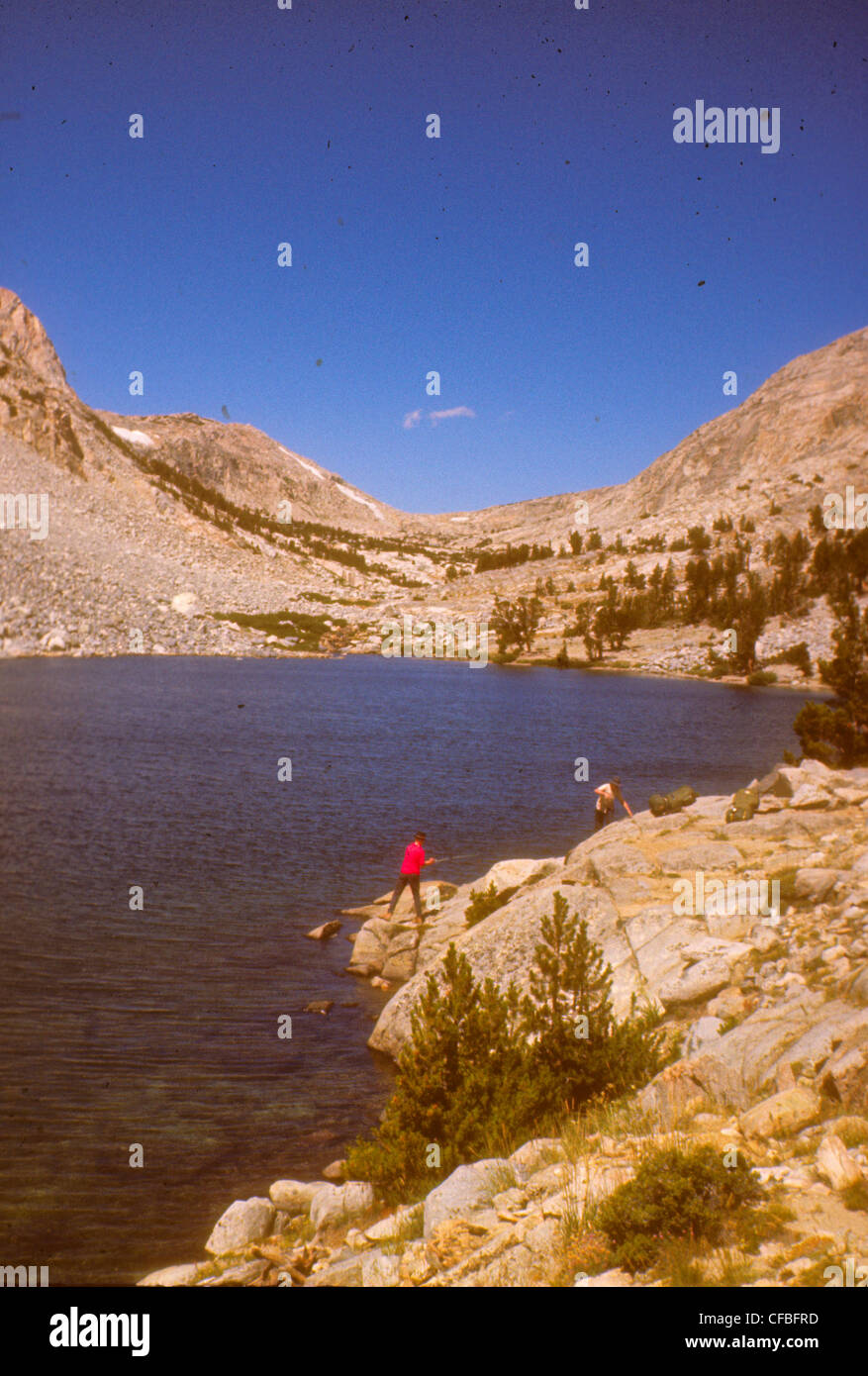
The photo below shows an area where dozens of fish stacked up there lazing in the sun and taking whatever bug happens to enter their feeding lane.I would add that casting a fly to water covered with the dimples from rising fish at sunset is an incredibly satisfying way to close out the day. How big are they – look big in the pic. They are brookies?gotta disagree on the frog thing – trout are in my opinion a minor factor in their disapperance. At my favorite lake for huge golden trout, I saw a beautiful yellow leg frog lounging about just a couple weeks ago.carefully examining the data, we’d see that something else is primary factor for the frogs’ decline. I’m voting pesticide, as there is some clear evidence there that is being avoided by many because of the powerful agri lobby in the central valley.study was done while back that Ralph Cutter cites – found that in many lakes, PRIMARY food source is insects from central valley that have blown up to sierras and dropped – along with the pesticide residues. Cary,The fish in the picture are all Brook Trout in the 12 inch range. Without a a known object for reference it’s difficult to get a feel for their size.
The photo covers perhaps 20% of that particular congregation of trout. Within 50 yards there were at least three other schools nearly as large. Lots of cruising singles along in the deeper areas of the shoreline too.The frog comment was just my weak attempt at humor. Perhaps keyed by some of the studies I’ve read in the past I did notice that lakes with no fish tended to have a population of tadpoles. Guess that makes sense from the preditor/prey perspective, as well as habitat compatibility, but the pesticide argument makes the most sense to me. When you are in the High Sierra the area seems invulnerable to outside influence but one look at the map and you realize it is a relatively small geographic feature in a region completely dominated by mankind.
This is a little off topic because its not JMT related, but on my day hikes here in Japan I frequently saw guys catching fish using bamboo poles. So I bought a light telescoping fishing pole and asked a sales rep for recommendations on hooks and bait. I have no idea 'how' to fish other than throwing a hook into the water, but I am going to carry this 1/2 Lb kit and try my luck. I usually camp by a river. I think it would be a great way to supplement my dehydrated and not-too-tasty backbacking food.
Thanks to those who replied. I am hiking the JMT this August and trying to nail down my gear list.
I have a 5 weight 4-piece rod, but it does not pack very small even though it is a 4-piece. I looked at the Cabelas rods which several on this site use and they are a good price. I am not sure.Another question,Has anyone used the March Brown travel rods? They pack really small, but I am not sure how they cast. Any experiences would be great.Brett-Good job getting some fishing equipment. I hope you eat well and enjoy yourself! Fishing is one of my other favorite activities.
It will be very fun to backpack and fish on the same trip! Yeah, I agree with FastWalker on the rod selection. Though I've no experience on the JMT, my choice for a pack rod that's versatile on small creeks or bigger water is a 4-wt.The7.5' is a really good length; you can still caste with some distance and have reasonable control for mending. I DON'T have one though and carry a 4-wt, 6.5' White River ultralight (Bass Pro Shop), 3 piece.
I use one of those clear tubes sold on BPL's website. The action on the rod is med-fast, and with little practice you can throw a #12 or #10 size wooly bugger if you want. Doing it again I would go with a 7.5' 4-wt 4-5 piece. A small arbor reel loaded with Double Taper line.
I'd cut the DT in half and save the other half for another reel, or for when the line needs to be replaced (stored in a ziplock bag in the freezer). I don't need that much flyline for a 4 wt or lower. I'd rather use the saved space on the reel for backing. Cabelas and Temple Fork Outfitters make great rods – well priced.
I have fished my 4wt with 3wt line and it seems to work well for low, clear creeks where you need more delicate presentation. I own the smallest Bass Pro Ultralight. White River 3 piece 3 wt. For $175, it was not a bad deal for rod, rod tube, reel, backing, flyline, and leader.
The rod is great for stealthy approaches to heavily wooded streams and good for short casts. The rod does well with small trout, but a bigger trout means you have to use the reel which is very small. As far as casting goes, the rod is just OK. It is pretty soft at the tip and takes a little longer than some of today's fast action rods to load-up. The included flyline is of poor quality, and has a lot of line memory.
I often find myself trying to straigten the flyline if it has sat on the reel for more than a couple of days. The flyline is also very short, so longer casts require pulling out a few yards of backing.
As far as a 'beater' rod goes, this rod gets the job done. Unless you are an experienced caster, I would go with a longer length than my 6'3'. The 6'3' will not allow you to cover a lot of water from the shore of the JMT lakes. I would also recommend the 4 wt. Because I feel that the 3 wt. Casts more like a 1 or 2 wt.If you are looking for a very nice rod that is of much higher quality, consider the Sage Launch 4 piece 3 wt.

It is a very light rod and casts well. You can get a package deal on Cabelas for about $260. A little more price, but you will get better flyline (RIO) and a reel that gives you the option of setting the drag.
Also, the 4 piece setup is idea for the JMT because you can break it to two pieces for a quick jump from spot to spot, and put it away in 4 pieces for fishless travels. Hi,I hope to see you out there this Augustwe are shooting for a start date of 8-1-07. I have thru-fished the JMT 3 times (02,03,05) and can say it is fantastic! Hey David,Unless you are a purist and enjoy the fly rod, go with the ultralight spinning rig. SOOO easy to use, sooo easy to catch fish! I must admit, not much of a fly man.but the spinning outfit is easy to assemble, easy to pack, nice in tight spots along the streams and has never failed me!Seems like Larry, you and I will be leapfrogging along the JMT this season.will hope to see you or hear about all those smallish but FUN trout you are sure to catch. Email me at: and I will let you in on a few of my secret hot spots!'
John Muir Trail Fishing Bishop
Bring a lightweight spinning setup and use a casting bubble with dry flies – best of both worldsi do this a lot and it works well – especially when casting is tough with flyrod due to wind or bushy stuffi have a 4 piece inexpensive breakdown fiberglass rod from eagle claw that is very sensitive, so little fish still feel big, but strong enough to handle a big trout should you be lucky enough to find onewithin easy day hike distance of JMT in a couple spots, I've found big fish a few times (around 18 – 20+'), though the vast majority are small.
John Muir Trail Topo Map Series – with UTM coordinates and gridsI used the National Geographic TOPO! Series to create these maps. I downloaded the.tpo file from the Map Exchange.
John Muir Trail Map
This.tpo file was posted by Dan Braun, Founder of Southern Yosemite Mountain Guides. All map notations are from that file and not checked by me, yet! The maps are formatted to fit on a regular size piece of paper. The full size map image is larger, so you can scale the map to larger sizes.NOTE: See links at bottom of page to download whole series in one file. Follow this link for an for correctly printing maps.